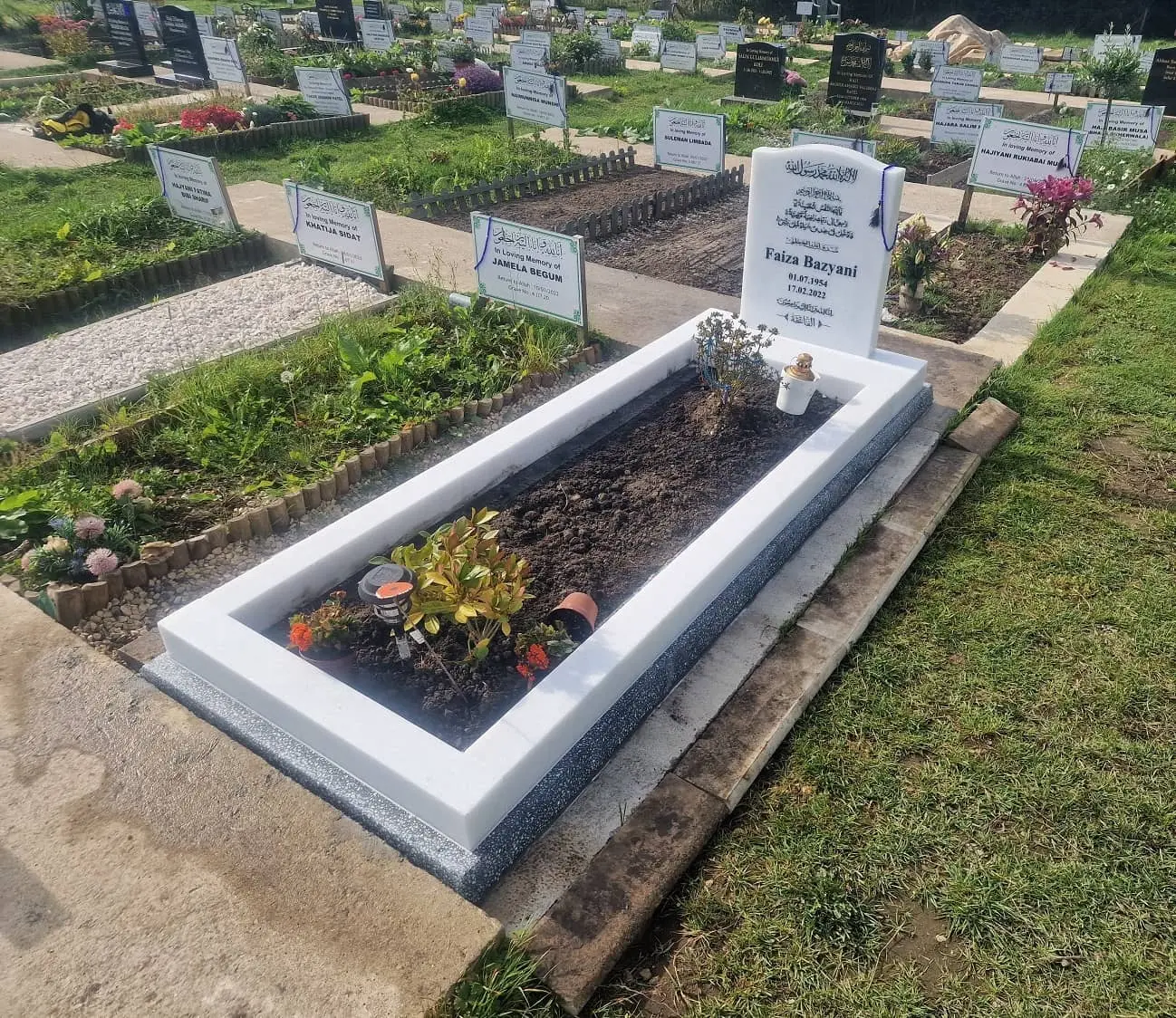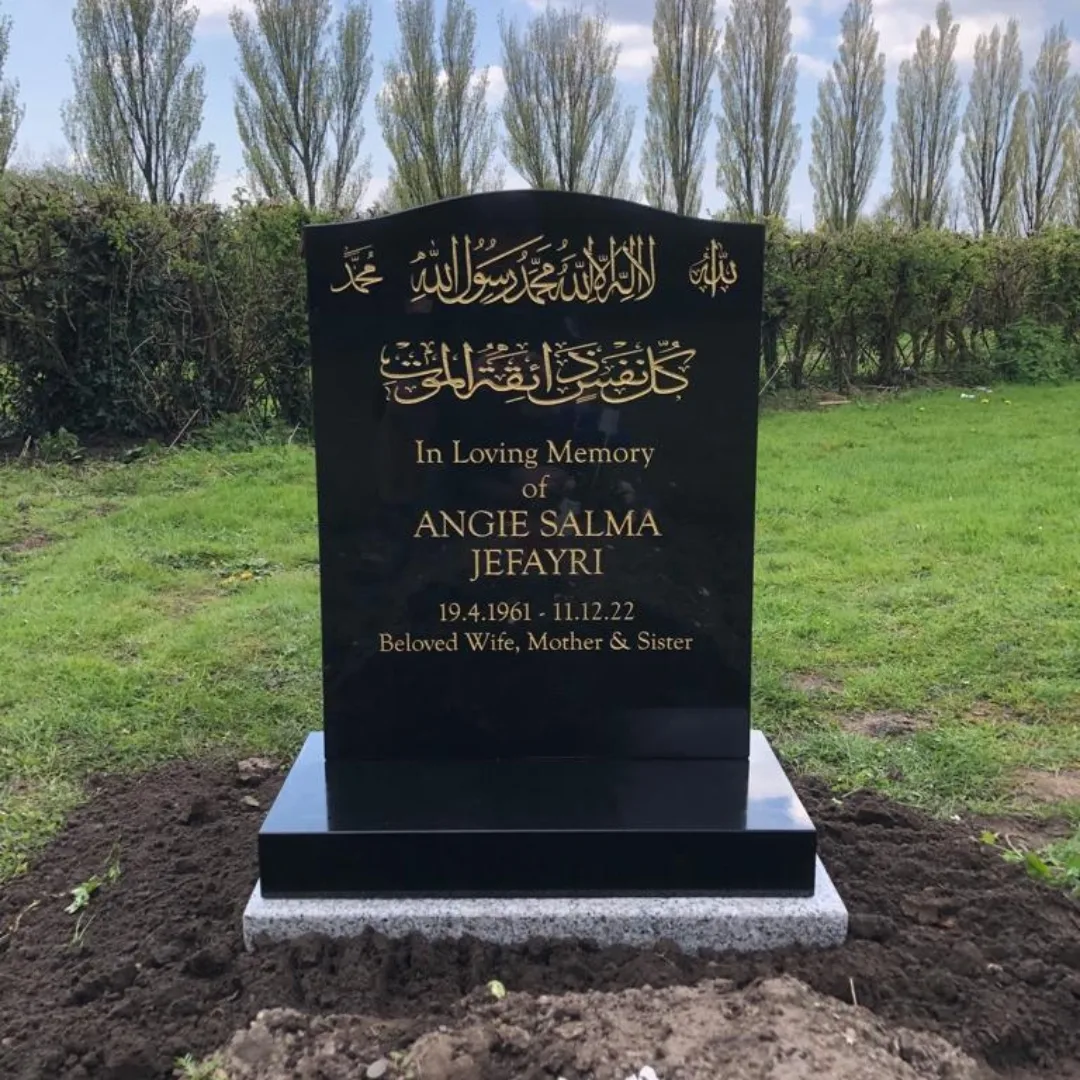
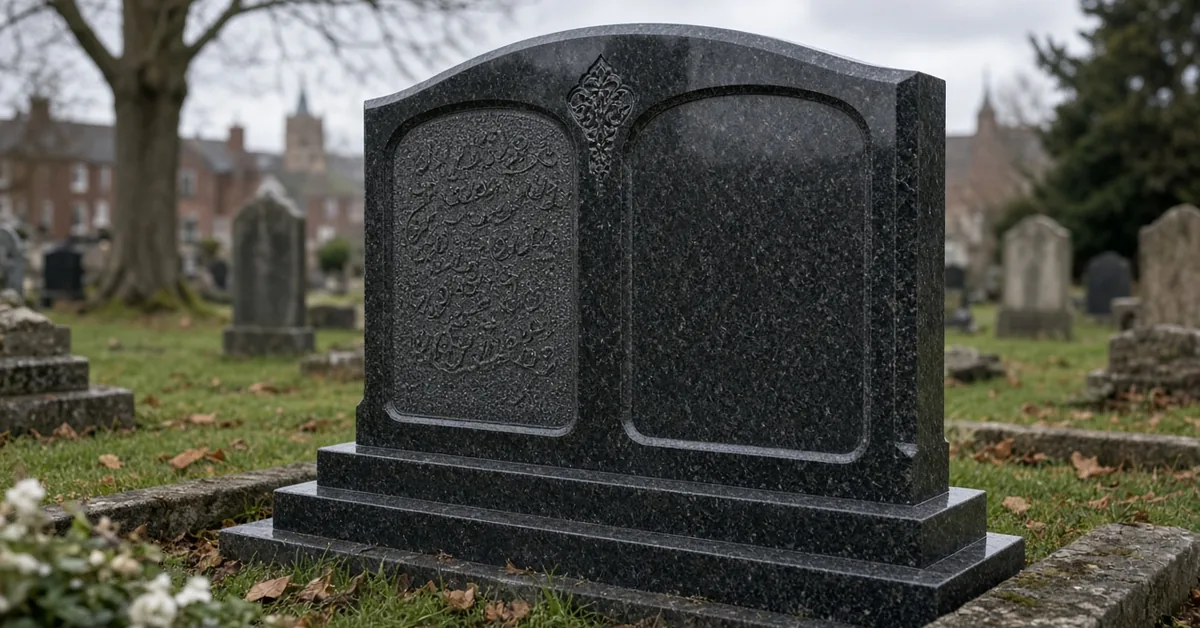
Arabic and English work well together on a headstone when each script has enough room and a clear place in the design. The main decisions are how much wording to include, how to arrange the languages and whether the smallest details will remain readable at the finished size.
Al Nour’s inscriptions and calligraphy service includes English, Arabic and multilingual lettering. A successful layout starts with the exact words your family wants to preserve.
Decide what each language needs to say
Prepare the Arabic and English wording separately before fitting either onto the stone. Decide whether both versions will carry the same message or serve different purposes. You might choose an Arabic prayer alongside an English dedication, while repeating the person’s name in both scripts.
Keep one agreed document containing the names, dates and final wording. Label translations and pronunciation notes clearly so they cannot be mistaken for text to engrave.
Have a fluent Arabic reader check spelling and meaning. For religious passages, ask an appropriate faith representative to confirm the wording and its suitability. A familiar phrase copied from an image still needs checking.
Choose a layout that gives both scripts room
Work from the usable face rather than the stone’s overall measurements. Curved shoulders, borders and flower containers can reduce the space available or visible for lettering. Mark those areas on the layout before choosing line lengths.
On a narrow upright headstone, start by testing separate blocks arranged vertically. Placing two long inscriptions side by side can leave each language with too little width.
One possible arrangement is:
A short Arabic passage near the top.
The name in Arabic and English on separate lines.
Clearly grouped dates beneath the names.
A brief English dedication lower down.
This is a design example, not a required religious order. A wider stone may accommodate two columns, particularly where the passages have similar visual weight.
Long names can use different line breaks in the two languages. Preserve their correct spelling instead of forcing matching lengths.
Centred text can work, but the edges do not need to match exactly. Avoid stretching a short line merely to fill the width. With a bespoke memorial design, discuss the lettering area alongside the stone’s shape from the outset.
Protect Arabic letter shapes and small marks
Ask to compare a familiar reading style, such as Naskh, with more decorative calligraphy. Judge the actual wording: an attractive sample containing three words may not suit a longer passage.
Arabic letters change shape according to their position and connections. Do not insert spaces between joined letters to make them spread across the stone. Line breaks should fall between complete words.
Many Arabic letters are distinguished by dots. These are part of the letters and must remain clear. Vowel and other pronunciation marks, where included, also need enough room above and below the text.
Keep decorative flourishes clear of these details. If the passage feels crowded, shorten the agreed wording or simplify the ornament. Never remove marks from approved text simply to make it fit.
Balance the visible size of the lettering
Identical font sizes do not guarantee that Arabic and English will look equally prominent. Compare the visible height, weight and detail of the finished lettering.
Ask the mason to specify the proposed dimensions in millimetres, including the smallest English line and the finest Arabic details. The workable size depends on the stone, lettering style and production method; a computer font setting alone cannot settle it.
Leave generous separation between lines, especially where Arabic marks extend towards the line above. If one language is readable only when the proof is enlarged, revise that part of the design.
Check reading direction and date formats
Arabic reads from right to left, while English reads from left to right. Numbers generally run from left to right within Arabic text. Mixed text can therefore display dates, brackets or punctuation unexpectedly when moved between programs.
Keep dates in a clearly defined line or block, and inspect their order in the final artwork. For English wording, spelling out the month, such as “12 March 1954”, avoids the ambiguity of an entirely numerical date.
If including both Hijri and Gregorian dates, identify the calendars and have the exact dates checked. Changing the numeral shapes does not convert a date between calendars.
Test contrast on the chosen stone
Readability also depends on how the lettering stands out against its background. When comparing memorial designs, ask to see a sample of the proposed stone and lettering finish together.
Look at it in daylight and from a slight angle. Notice whether reflections, surface pattern or fine strokes make any letters harder to distinguish. A bright screen preview cannot show every effect of the actual surface.
Ask which lettering finishes are suitable and permitted, and what care they require. Give both languages adequate contrast; making one noticeably fainter can undermine an otherwise balanced arrangement.
Review the complete proof before approval
Al Nour provides a digital design visual for approval before manufacture. Ask whether a correctly scaled print or dimensioned proof can help you judge the actual lettering size.
If printing a full-size proof, check its measurements with a ruler. Automatic “fit to page” settings can shrink it. View it from a comfortable standing position as well as close up.
Review the whole headstone, including borders and ornament, then check:
Every name, date and punctuation mark against the agreed wording.
Arabic connections, dots and marks in the final artwork.
Line breaks and clear gaps around each language.
Any space reserved for a future inscription.
Ask your fluent reader to review this final version, even if they checked the original text. After any correction, check the revised proof again. Keep a copy of the version you approve.
Frequently asked questions
Does Arabic always have to appear above English?
There is no single design arrangement for every family. Religious wording may bring particular preferences, so discuss placement with your faith representative and confirm the cemetery’s requirements.
Must every Arabic phrase have an English translation engraved?
Not automatically. Some UK cemetery authorities require a translation for their approval paperwork. Ask whether that is sufficient or whether your cemetery has additional inscription requirements.
Can Arabic be added to an existing English headstone?
It may be possible, depending on the remaining space, stone condition and permissions. Al Nour’s guidance on adding an inscription to an existing headstone explains what needs assessing first.
Will using two languages increase the price?
Request a quotation for the complete inscription. Ask how the amount of lettering, calligraphy preparation and chosen finish affect the price rather than assuming a standard bilingual surcharge.
Can a family member’s handwriting be used?
Share a clear sample and ask what can be reproduced legibly. Fine pen strokes may need adapting for the available space and stone; approve any changes before production.